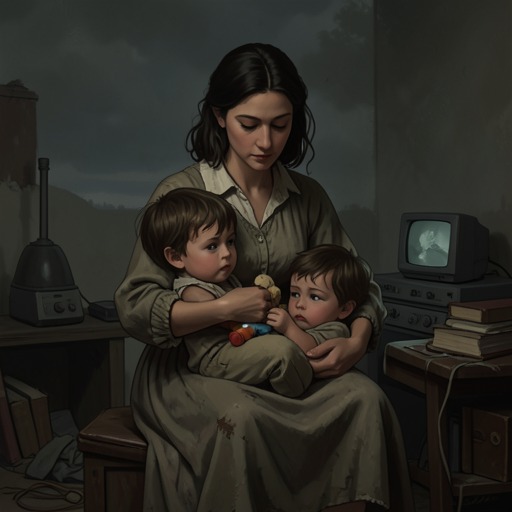
Ammu and Estha
The God of Small ThingsAmmu and Estha’s mother–son relationship is shaped by intimate childhood dependence and an irreversible separation: Estha fears that his mother will love him less after his abuse, yet when Ammu dies alone, he is not there to comfort her, and the family does not bring him into the news of her death. The unposted letter and the trunk Ammu packs for him give this bond its defining form: love made tangible in named possessions, then left without a path back to reunion.
Love, Fear, and the Body
During the taxi ride through the night, Estha leans out of the window into the hot, salty air. In the wake of what the Orangedrink Lemondrink Man has done to him, he imagines Ammu finding out and loving him less—very much less. Shame turns physically in his stomach, and he longs for the river because water always helps. The scene locates his fear not in any demonstrated rejection by Ammu, but in his own dread that what has happened to him could diminish her love.
That dread persists into the night. Ammu sleeps beneath barred-blue light, smiling as if in a peaceful dream of dolphins and deep blue. Estha wakes, walks alone to the bathroom, and vomits a clear, bitter, lemony, fizzy liquid. He feels a little better, puts on his shoes, and stands quietly outside Rahel’s door. His distress is rendered through the body and through solitary movement; Ammu’s sleeping presence offers no sign of the fear churning through him, and he does not wake her or tell her what has happened.
Separation and Ammu’s Last Return
The relationship is later defined by absence as much as by their earlier closeness. Estha never sees Ammu as she is when she returns to Ayemenem: wild, sick, and sad, with asthma and a rattle in her chest. On this last return, Rahel has been expelled from Nazareth Convent, while Ammu has lost another job, this time as a receptionist at a cheap hotel, after illness keeps her away from work. The account makes Ammu’s declining health and precarious employment part of the circumstances in which she comes back, but Estha is not present to witness her condition.
Ammu dies alone in a grimy room at the Bharat Lodge in Alleppey, where she has gone for a secretary’s job interview. She is thirty-one. The noisy ceiling fan is her company; Estha is not there to lie behind her and talk to her. That absent comfort gives the separation a precise, domestic measure: the loss is not only that mother and son have been parted, but that the familiar bodily closeness and conversation cannot be restored at the moment of her death.
A Trunk Packed for a Child Sent Away
An earlier bedroom becomes the scene of Estha’s departure. After the Twin Expert from Hyderabad replies, Ammu packs his little trunk and khaki holdall, marking his clothes with his name in ink. The carefully itemized possessions include sleeveless and half-sleeved cotton vests, socks, trousers, shirts, beige shoes, Elvis records, calcium tablets, Vydalin syrup, a Free Giraffe, and the first four volumes of Books of Knowledge. She adds his mug, soap, and white leather zip-up Bible, whose zip carries an amethyst cuff-link belonging to an Imperial Entomologist.
Ammu also gives Estha forty green inland letter forms, already addressed to her. She shows him how to fold one on its dotted line and asks him to promise that he will write even when he has no news. Estha folds it neatly and promises, but he is not wholly aware of what is happening to him. The abundance of things that belong to him, each identified with his name, blunts the sharp edge of his apprehension. The packing is therefore both care and preparation for separation: Ammu equips her son with possessions and a means of correspondence, while the scene shows how little he can yet comprehend about the parting.
The Unsent Message
After Ammu’s death, Chacko says the crematorium must have a system for identifying ashes. The possibility of keeping a record recalls Estha as the family’s natural custodian of receipts, tickets, and other papers. But Estha is not with them. Everyone decides it is better this way, and they write to him instead. The absent record-keeper is also the absent son: the family’s practical decision not to have him present leaves communication to a letter.
Mammachi says Rahel should write too. Rahel cannot do it. She thinks of telling Estha that Ammu died, but never writes; to her, writing to her twin feels like writing to a part of herself, as if to a foot, hair, or heart. In this aftermath, the correspondence Ammu had prepared for Estha remains an unrealized possibility rather than a means of reunion. The relationship ends not with a final exchange between mother and son, but with Ammu’s death, Estha’s absence, and the silence of a letter Rahel cannot send.